
.svg)
Episode Transcript
Episode transcripts are machine generated and may contain errors.
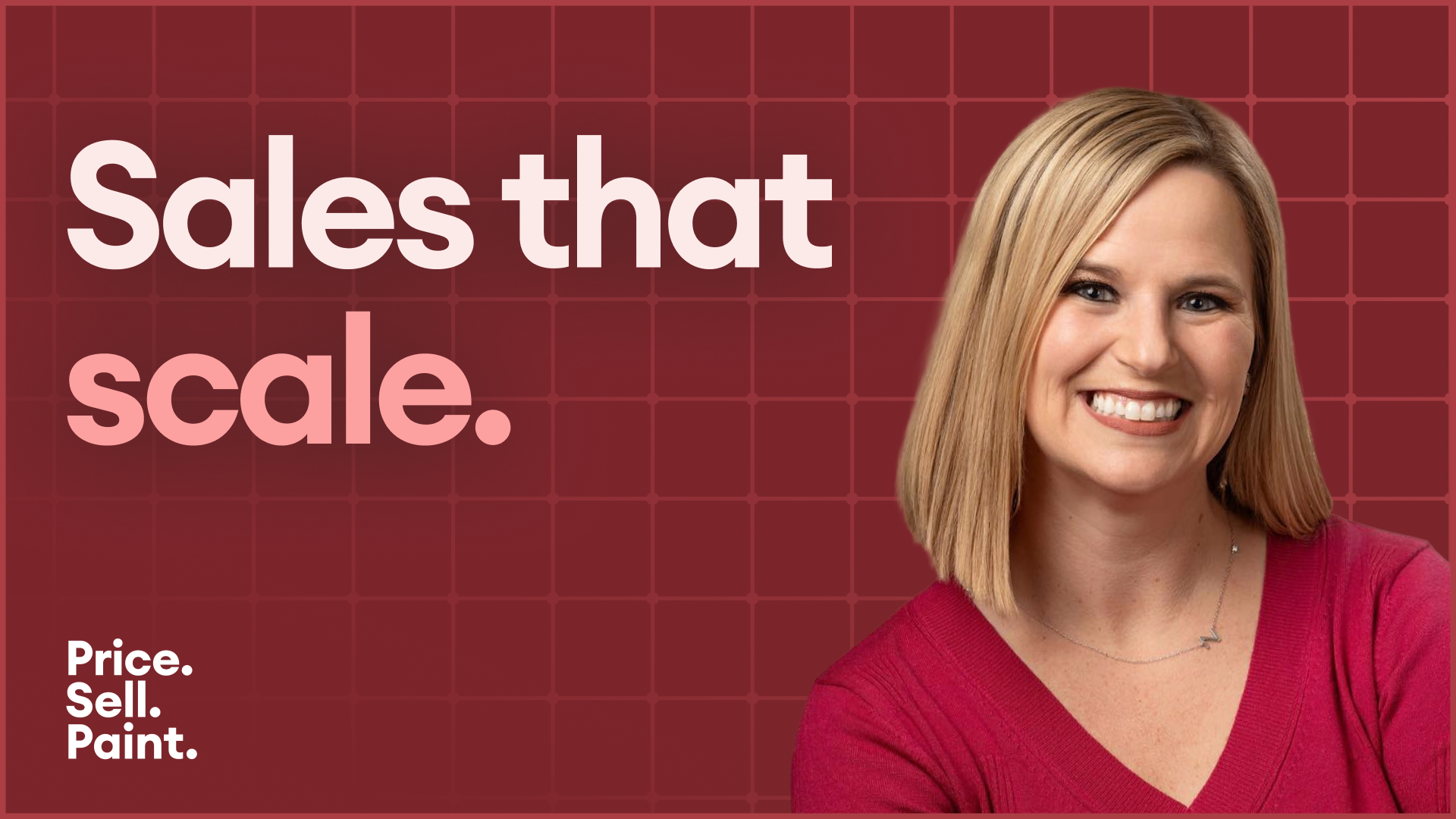
Michael Murray: Hey everybody, welcome back to the Price Sell Paint Podcast. I am Michael Murray, joined as always by the co-founder and CEO of PaintScout, Jon Bryant. Today we have a special guest, Jaclyn Rogers of AI Painting Plus in Columbia, Missouri. She is their client relations manager, and we're excited to hear about the amazing things she's doing selling painting services every single day. Jaclyn, tell us a little bit about yourself and how long you've been with AI Painting Plus.
Jaclyn Rogers: Thanks so much for having me. I'm Jaclyn here in Columbia, Missouri. My title is client relations manager — a lot of my role is estimating, sales, and business development here in our community. I've been with AI Painting Plus for four and a half years. My overall mission is to make meaningful connections, build relationships, and then let's talk paint and problem solve. Offering really high customer service is really important, and then the painting part comes with that. My day looks really different every day — I might have four estimates, I might have two, but I'm always out in the community. Whether that's leading a networking group, going to my paint vendors, or meeting with designers. It keeps me moving all the time.
Jon Bryant: What got you into this, Jaclyn? You're not a painter, you didn't come from painting. What got you into it initially?
Jaclyn Rogers: My background is retail management — bigger companies like Eddie Bauer, Limited Brands, White House Black Market. But for me, it's always been about the people. Having a client book, knowing who my direct clients are, being able to take a problem and solve it. I started doing that in high school. COVID happened, I had my son right before that, and quickly realized the retail world never stops. In the meantime, I had met Lacey and Austin Illsley back in 2012 when I moved to Columbia. I actually invited Austin to come to networking groups and talk about AI Painting back then. Full circle — I approached them in 2021 and said, hey, I see you're growing, Austin's really busy estimating, painting, project management. Where can I help? I had a lot to prove. It was Austin's baby, his name, his company. We sat down and said, what is this role going to look like? Let's create it, tailor it to me, but let's also prove I can sell paint even though I'm not a painter. I went on ride-alongs, did shadowing. The customer service piece and the listening came naturally. The intimidating part was walking into a room not knowing how to measure things — which, by the way, is what you shouldn't worry about as a sales rep. The estimating part is the easiest part. They really took a chance on me. Lacey knew I was competitive, knew I'm a go-getter. It's been so cool to see the small business culture. The painting world is very male-dominant, but I think women are underutilized. I used to have a little head trash about that. I'd meet a sweet older man for an exterior project and he'd say, "Well, you're gonna be the painter." I used to let that get to me. Now I'm like, you're right, I'm not — but let's talk about what you're looking for and make sure we're a good fit. If you're getting into this role and nervous about that, don't be. We have an advantage because we're not guessing — we're using data. When people ask me how to find a Jaclyn, I say go to the mall. Go to the retail workers busting their butt making the wheels turn. That's who you're looking for.
Jon Bryant: Let's sit in that idea a little — being a woman in this space. It's a superpower in this industry and underutilized. You mentioned you had some head trash. What did that look like?
Jaclyn Rogers: On two ends — you have a team hoping you're going to produce work for them, and they're hoping you know what you're doing, because if not, they're the ones feeling the repercussions. So creating a safe space with your crews, your project managers, your owners — you have to be open-minded because you're going to mess things up. Being coachable is really, really important. The second layer is just not overthinking it, listening to everything the client is looking for, and if we can't do it, having those conversations. Austin trusts me to make decisions on a job. If I'm questioning something, we go back and say, hey, maybe don't do it like that again. I'm very type A — I need to know exactly how things happen. This was a pivot for me because there's a million ways to do something, and as long as the end result happens, that's okay. We switched estimating softwares this year. I was excited and also really nervous because I only knew one way to do it. But it's been significantly better — now I really get to focus on the client. The estimating shouldn't be the daunting thing that takes forever. My first couple of bids I was there for two and a half hours, just worrying about typing in data instead of learning more about the client. I had to slow down that process to speed up in other ways. I'm very honest in my sales process — I'm not trying to pretend I'm the one doing the work. Some of the people I'm competing against are painters with a piece of paper handing it to the client. I like to take my clients through my process and say, we use these rates because we know what it takes, we job cost and make sure our teams are set up for success. If they're an ideal client, they appreciate that. They're like, fantastic — you're not going to knock on my door and tell me you need more paint because you guessed wrong. We want to slow down the process so the client sees the value and trusts you. That's the biggest thing — making sure there's trust, because then they know I have their best intentions in mind.
Michael Murray: So you're using production rate estimating, you have data and science behind your numbers, and you're also highlighting that for the prospective customer and using it to compete against someone who isn't. Am I hearing that right?
Jaclyn Rogers: Absolutely. I like to be super honest and open about what I'm doing. And for the record, there are so many awesome women who are painters — that's just not me, I'm a messy person. But yes, Michael, I use it as leverage and as an opportunity to say, hey, we are organized, we are professional, we do update things. This last year we were able to speed up a lot of our rates because we changed crews and grew. Those are things now that come up in my sales process. If my client says they're getting another bid, I always say, I want to create a space where you feel comfortable telling me if my numbers are way off. And I'll say that not as a negotiation, but to ask — what are we missing? Was there something I'm giving you that they're not? The details are really important, and I want them to know I'm not just guessing. Give me 15 minutes and I'll sit back down with you and we'll talk about it. 90% of the time they're like, wow, okay, this is great. So if you're not using estimating software, if you're not using PaintScout, you need to. That is it.
Jon Bryant: That's the message we hope everyone takes away. You mentioned that process was taking you two and a half hours — where are you at today?
Jaclyn Rogers: Obviously depends on the project, but maybe 30 minutes for the estimate itself. I'm a talker, so if the client wants to open up and tell me their whole story, I'm here for it — that's my bread and butter. But the actual estimate creation is so fast. I love the templates. I have my projects set up and my templates loaded. If it's an interior, I have all my interior product photos ready. If it's exterior, the exterior presentation is ready. The more prepared you are walking in, I have my tablet, five minutes, boom boom boom — here you go. They can sign on the spot and I take their payment right there. I'm spoiled. I love it.
Michael Murray: That's the right answer. How often do you get questions about the AI in your company name having to do with artificial intelligence?
Jaclyn Rogers: All day, every day. When I ask how they heard about us, or they ask me about the name, I say it's a really cool story — AI stands for Austin Illsley, our owner. He opened the business in 2013. I joke that he's just a guy who was very wise. We have a great brand, great community involvement, and once you see the logo you can't unsee it. So I don't see a rebrand in our future. But then I lean in and say, we do use software, we do use production rates — there's our AI. I promise my team lead is real and they'll be there on your job. We kind of laugh about it.
Michael Murray: Austin's parents were ahead of the curve with those initials. He could probably sell the domain for something.
Jon Bryant: Tell us more about the networking groups and how that impacts your work — your involvement in chambers, BNI, relationship building.
Michael Murray: Yeah, how much is networking and relationship building impactful in your everyday role?
Jaclyn Rogers: When I took this position, I didn't want to just do appointments. I didn't want to sit around and wait. I'm the type where I see so much opportunity — I want to self-generate business and build reputation. So I plugged myself heavily into the chamber here in town. There's a women's network division, which is the largest division of our chamber — around 300 members, though men are in it too. It's mostly insurance agents, real estate agents. No other painters, no other contractors. I got involved in committees, connecting with people over coffee, talking about paint so I'm fresh in their minds. I'd go to those events with the intention of talking to three people I'd never talked to before — just to get to know them, and then follow up about painting. The chamber was a really big portion of that. The second one that works really well for us here in Columbia is BNI — Business Networking International. Some people have biased opinions, some love it, some hate it. I love it. I'm the only painter in my group. I ended up taking leadership positions. The visibility has been great, and professionally, it's helped me get comfortable with public speaking. I started AI Painting in February and the very next month I was like, sign me up for everything. People laugh and say we're everywhere. I'm like, yeah, that's the point — then you remember me and you remember AI Painting, and it has a ripple effect. For sales reps, you can't wait for jobs to come to you. I've had people ask me how I get referrals and I say just by authentically talking to people — not coming in shark mode like let me give you a painting bid, more like where do you live, what projects do you have going on, and the painting conversation comes naturally. Year to date I usually generate about 40% of the estimates I close myself. In our college town, the population goes away in summer but residential picks up. I've met sorority house moms, Mizzou athletics, property managers — all relationships I authentically built that trickled into business. I do best when I can really connect with the decision maker directly. And having those connections have really grown us and grown me professionally.
Jon Bryant: For everyone listening who's tried BNI or the chamber and it hasn't worked — it sounds like you've really found a way to get value out of it. Is there anything beyond authentic conversations you'd add for getting the best out of something like BNI?
Jaclyn Rogers: I think the biggest thing is not going in being selfish. Your time is important and you're getting paid to be there, but also ask yourself who around you can you genuinely help? The mindset should always be I'm going to give more than I get back — and usually on paper it ends up even or more. I try to be purposeful with people I know I can help. Yesterday I had a client I was meeting for a siding and staining project, but their whole house was falling apart. That's not a fun conversation. But I have people I trust that I know can take care of them, so I'm making my client feel like they have a trusted partner from beginning to end. I'll say, you can call whoever you want, or I have someone I think you should look into. Then I'll call that person and say, hey, I just met this client I think is a good fit for you. There's legwork involved. You're not going to go to those meetings and have it all come to you. Those are usually the people that don't do the best. My role is different — Austin can't commit to BNI because he has too many other things happening, but for me it's part of my job to self-generate and also put into it. Having a strategy helps. I don't think there's a bad strategy. Everyone walks into those rooms feeling the same. It's about what you hope to get out of it and allocating the time to do it. If you've visited a group and didn't feel any of those things, that group's probably not for you — but there's probably one 20 minutes down the road.
Jon Bryant: One thing that stuck out to me when I did BNI was the concept of givers gain — learning how to actually network rather than just handing out business cards. Going in present and real and identifying opportunity for others — that was the key.
Jaclyn Rogers: Absolutely. And a little plug for BNI — you can still visit groups every six months without being a member. So if you're in a rut and want to freshen things up, just go check it out. People expect immediate satisfaction from these groups and it just takes time. Being patient is important. I also couldn't do any of this without Lacey and Austin's support. When I go to these events, those time slots are blocked off — I position them just like a client meeting. If I could easily cancel it, I probably shouldn't be there. AI Painting understands the importance of it. If my owners didn't have my back, I couldn't do it. When I'm presenting or there's something special going on, I get Lacey and Austin in the room. Austin loves it. Lacey gets nervous in crowds, but she's always happy after. It's cool for them to see me in that role too.
Michael Murray: I hear the long-term mentality. Most sales reps think about doing these things when their calendar is half full in January, thinking by February they'll have all these leads — and most things in life don't work that way. How do you balance all of this? You're a mom, you're selling jobs, you have all these appointments, and you're still finding time for networking. How do you divvy up your time?
Jaclyn Rogers: Four estimates a day is usually my cap. We discovered that to make sure there's enough time for lunch and for the extra things. I schedule it out as early as possible, and if I have pockets of time, I fill those spots. This morning my first appointment wasn't feeling well and had to move. So I popped over to another networking club I'm part of instead of catching up on emails. I self-manage using Google Calendar — everyone on my team can see where I'm at. I also create work-life balance for myself. I don't do estimates on weekends, I don't do evening estimates. Some networking things happen in those times now. The last month and a half I had four estimates every day, five days a week, so some networking looked a little smaller. The things that stayed consistent were my women's network and BNI commitments — they take attendance and I'm not going to look bad on paper. It's about holding myself to that standard of accountability. Life still happens — your kid gets sick, you get sick. My son was a kindergartner this year and I was the one who got sick. But making sure I get those clients back on my schedule and keep selling jobs and providing work for my guys is number one. I have a weekly meeting with our team — job leaders and all our painters. I talk about what I'm doing out in the community because those painters are the ones people see. The vans, the yard signs — people call me and say I saw your painters, I want a quote. I tell them the why behind what I'm doing, and I show the data that proves it. You don't want your crew thinking you're just out selling jobs for the sake of it — they need to trust you're setting them up well too.
Michael Murray: It sounds like over four and a half years you've learned a lot about setting the crew up for success. What are some tips and tricks when putting together a bid, taking photos, preparing the crew to win?
Jaclyn Rogers: The overall thing is not being daunted by the space you're walking up to. When people get into painting, all they look at are the imperfections everywhere. Number one would be familiarizing yourself with the products to actually make things look good — prep is important, but if you're not using good products it won't look good either. Familiarize yourself through partnerships with your vendors or working with your job leaders on your top three go-to products for walls, trim, cabinets, and exterior substrates.
For me right now, if I get an estimate scheduled I go into PaintScout and future-date it. I preload all my interior wall paint products on a product specification. When the client tells me what they want, I can just delete what doesn't apply and switch it over. Saves so much time. I also love that I can do all my prep, put it on airplane mode, and be ready to go on-site — or copy an estimate and just edit versus starting from scratch.
Before, I'd be measuring walls, then trim, then ceilings separately. PaintScout makes it easy — I put in one wall measurement and it gives me the trim and ceiling based off that one number. It really cleans it up and makes it feel less daunting.
There are still things where a production rate doesn't solve it. If you're starting out, lean on your production managers. I don't go to them with, hey what do I need? I'll say, hey, I have this bid for eight hours, two gallons of paint, one washing hour — does that sound right? Sometimes they say no. Sometimes they say let's try it. Once it happens, did we get it right?
I also created a Google Sheet I call my PaintScout task tracker. If I come across something I want to change for the future, I assign myself to look into it. When we have our weekly production and sales meetings, I bring those up. Hey, I noticed the brick spread rate seemed a little low — here's what I noticed, do you guys feel comfortable with me changing that? It's an open, candid conversation. You're going to mess up. The good news is it's just paint — we can fix it. I've overbid, I've underbid. When we switched softwares I said, hey guys, give me some grace, this is new, and I need you to tell me when something's not right because I can't fix it if I don't know. Having a strong relationship with your owner, manager, or production team and creating that space is everything. I was nervous coming in — these guys didn't know me, I was the only female besides Lacey. But I put in the work and the effort and figured it out. I love Good to Great by Jim Collins — you've got to have the right people. And Soundtracks by Jon Acuff, which is all about positive mindset. The more you feed your brain negative energy, the more you feel that way. When I've been told no three times in a row, I lean hard into that. I used to take no personally, used to want everyone to say yes. I've come to realize that's not the case and that's okay. I started asking clients who told me no for feedback. Maybe it was price, maybe it was timeline. Those are things I bring back to Austin and Lacey — maybe we need to look into that service or that offer. I always say yet, because you never know. And always ask your winning clients why they hired you. Not to boost your ego, but to really understand what allowed them to say yes. Maybe your bid was higher but more detailed, and they saw the value. Be positive, assume you can do it, and be open for connection.
Jon Bryant: Last month was your record month. Walk us through it — why do you think it happened?
Jaclyn Rogers: It was really about re-engaging people who just hadn't made a decision yet. 30 days is typically where we want to close, but sometimes people have other fires to put out. I stay really low pressure with them, but I'll give them a little nudge if they're trying to hit a specific date. My mindset was just being more prepared — having my templates ready, CompanyCam set up, being able to sit down with them and get them to sign right there or set a clear next step. My win rate was right at 42%. The revenue win was even stronger — I had some smaller jobs but was able to capitalize more on the revenue side. It was close to $300,000 in a residential market of 150,000 people in the summer when all the college kids left. Record breaking is hard because then you feel pressure to do it again. My number to beat had always been $230,000 to $235,000, and it was significantly higher. Today I'm not having a record-breaking month yet, but I use it as motivation, not defeat. I break it down week by week. And usually in our world, if I don't get it this month, those clients are still there next month. Give yourself grace to stay on them without burning out or getting frustrated. If you're walking around mad, you're not helping anybody.
Jon Bryant: You mentioned it's hard getting no's and you want to be liked. What changed for you — how did you get to the point where you realized it's about the homeowner?
Jaclyn Rogers: Honestly, the repetition of it. And then asking yourself — is this going to fire me up or bring me down? I leave it at the door. It's paint jobs, we're grateful for this work, but the next day starts over. You can get an email at any moment from someone accepting a $100,000 project — you just don't know. Personal development audiobooks help me a lot. The Energy Bus is another one I love. It just allows me to be okay with feeling that way. The other thing is putting it on paper — is there a pattern as to why they told me no? And then going back through past bids too. Third is asking clients for feedback. Multiple people who told me no gave me great feedback. Maybe it was price, maybe timeline — things we sometimes can't change. The hardest yet maybe easiest part is realizing there are so many other opportunities. I handwrite notes to every completed project — I'll often write out the name and address before the job even starts. But I've also handwritten notes to people who told me no, because I still want them to know I appreciated the opportunity. I've gotten clients from that. They hired someone else, then called me later because I took the time to say it was nice to meet you and thanks for the opportunity. I also tell clients in the sales process — at any moment, if we're not a good fit, I want you to feel comfortable telling me. No hurt feelings. I want them to feel safe enough to just say yeah, this isn't going to work. Looking for patterns, staying positive, personal development, and asking for feedback — those are the things that continue to make you better.
Michael Murray: Jaclyn, we've met before, but for anybody who hasn't — I think your energy and positivity are just who you are as a person, and that has a huge part to do with your success. You come across as genuinely interested in people. You have this mentality where you're going to go meet somebody interesting, have an awesome conversation, and if you end up painting for them, great. If not, that's okay — it's another awesome person on your journey. That's so refreshing and not transactional. That's why you're having so much success.
Jaclyn Rogers: Thank you. I truly believe that too. If you're around someone in a bad mood, you feel it — it's contagious. If I carried that into a client appointment or a meeting I'm supposed to lead, everyone would walk out. At the end of the day, I'm tired, I go to bed early, I wake up early and work out at 5 a.m. Obviously some days I skip it. But I still walk into the day happy. I want my son to see that — I want to be that influence for him as he makes friends and does his activities. So thank you, that means a lot.
Michael Murray: As we start to wrap, is there any last parting wisdom for somebody experiencing that same hustle every day?
Jaclyn Rogers: A couple of things. Connect with like-minded people. Competitors in town, colleagues in town — the more we work together, the better we all look. Whether that's LinkedIn or running into someone at Sherwin-Williams and grabbing their card. I have a painting contractor in town who does a lot of new construction. We see each other and they always honk and wave. I love that. We're both out here, we're both busy — that's great.
Number two — get PaintScout if you don't have it. Don't be afraid of switching over. I was nervous, but they made it so easy.
Number three — don't have self-doubt. I'm a confident person, but not a cocky person. Be proud of what you're doing. This world is growing, and people just getting started have way more advantages than we had even four years ago. Get involved, connect with others. My bar is really high because my owners saw the vision and invested in things like PCA and Nolan Consulting Group. I now know no different. And that's exactly where you want to be.
Jon Bryant: Jaclyn, that's amazing. Thank you so much. For those listening, Jaclyn is open to connecting — whether by call or email. Her story is really inspirational and for anyone in our community, especially women doing great things in this industry, we hope this helps. Thanks for being on the Price Sell Paint Podcast.
Jaclyn Rogers: Of course, thanks for having me.
Michael Murray: Jaclyn, what's the best way for people to reach out to you?
Jaclyn Rogers: Email works great. It's J-A-C-L-Y-N at AIpaintingplus.com. No K or Q in Jaclyn. Reach out anytime — we can set up a call, whatever works. I'm sure I'll learn something from whoever I get to talk to too.
Jon Bryant: Amazing. Thank you, Jaclyn, for being on the Price Sell Paint Podcast. If you're following along and you enjoy the content, feel free to give us a like and subscribe. We appreciate you all — we'll see you next time.