
.svg)
Episode Transcript
Episode transcripts are machine generated and may contain errors.
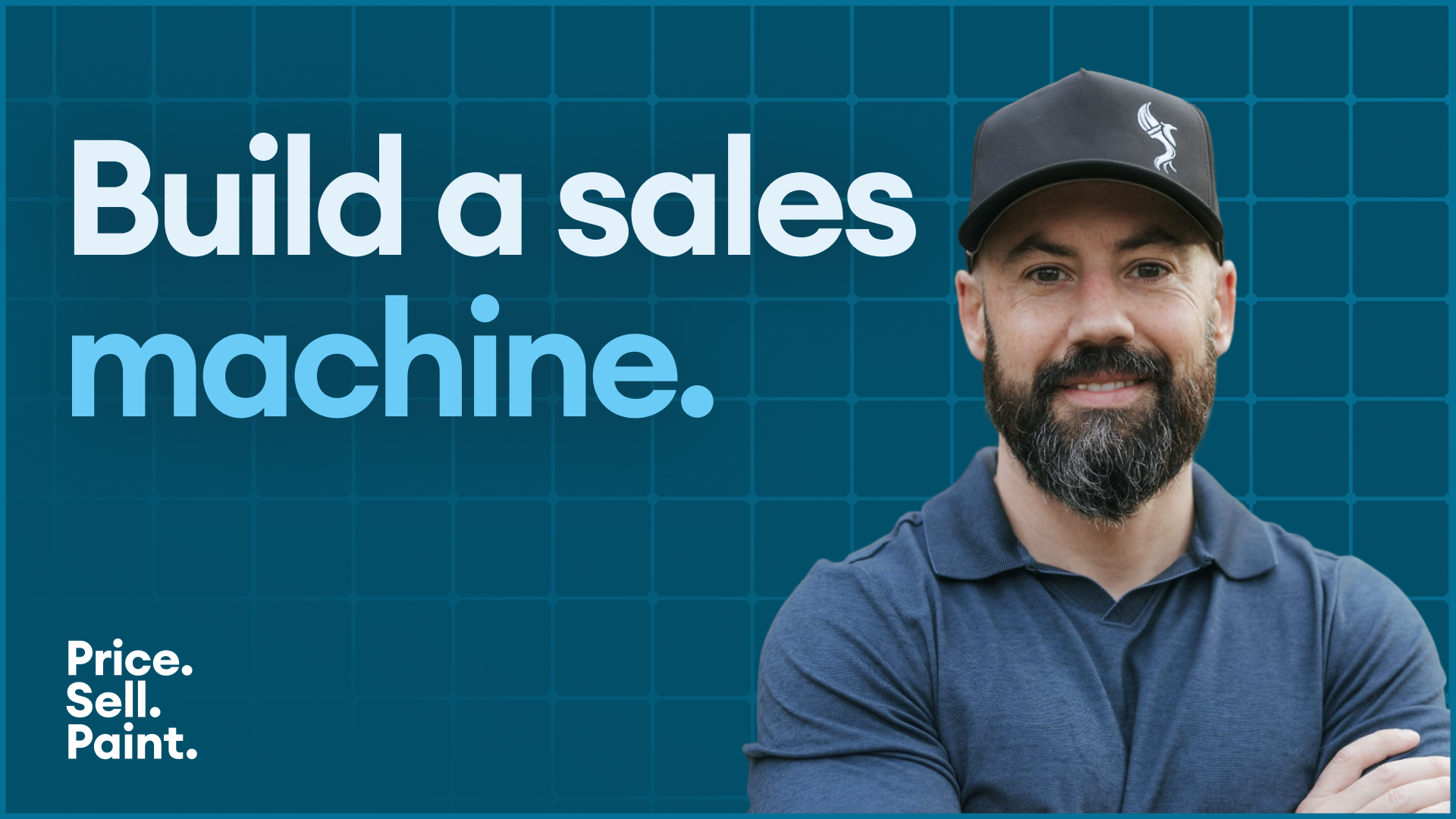
Michael Murray: Welcome back to the Price Sell Paint Podcast. I'm Michael Murray, joined as always by Jon Bryant. Today we're lucky to have a special guest — Brad Ellison from Ellison Painting, also a PCA board member. Brad's got a lot of unique perspectives on what's happening in the industry right now. Brad, tell us a little about yourself for those who don't know you.
Brad Ellison: Thank you for having me. I own a painting company in Metro Detroit that's grown pretty quickly over the past four and a half years. I serve as vice chair of the PCA. And most importantly to me — probably least importantly to everyone else — I've got a great wife, three kids, and a fourth due December thirteenth. I'm genuinely living the dream.
Michael Murray: Even more blessings on the way. Awesome.
Jon Bryant: So growth is such an interesting part of your story. Four years in business with this kind of trajectory is exciting. Before the podcast, Michael and I were talking about Metro Detroit — we've spoken to so many people from there and keep asking ourselves how it became this hub for large painting businesses. What's your take on that?
Brad Ellison: We do interior and exterior. When I first got exposed to the people we all know in common, Minneapolis was the hub — probably because guys like Jason Ferris and Nick Slavik were working to professionalize the industry and it spread locally. I'd like to think I played some part in expanding that message here in Metro Detroit. There were already big companies like McFarland Painting — he was doing over $10 million before I even knew who he was. Metro Detroit is a great market with a lot of money in the suburbs and a large population — probably two to three times the size of Minneapolis Metro. Now there's a handful of professionalized companies leading the charge and raising the tide. We might be second or third largest in the state for residential painters, though McFarland's still ahead of us.
Michael Murray: You started Ellison in 2022, but you worked at another company before that. Can you talk about that origin story?
Brad Ellison: I stumbled into the painting industry about nine years ago. My wife and I had a health insurance agency and needed something to do in the off season. We met a guy at church who owned a painting company — he was looking for someone to sell and manage the business and eventually buy it. I didn't know anything about painting, but I knew sales. We met Sunday, had coffee Tuesday, worked out details, and were off. I ran that company for about four years before we decided not to purchase it and instead launched Ellison Painting. When I started Ellison, I had years of experience under my belt, knew what worked and what didn't, but couldn't make changes because I wasn't the owner. That gave me a real leg up.
Michael Murray: What was the deciding factor on not purchasing it?
Brad Ellison: Essentially financial. We'd agreed on a purchase price based on something unrealistic. When I went up to Minneapolis and met Jason Ferris, he ran through the numbers and showed me that moving forward with that deal would be financially devastating to our family for the first three or four years. We tried to renegotiate — offer some upside for a lower entry fee — but it was the original deal or no deal. So we said no deal, and I started my own company. It ended up being the best thing that could have happened for us.
Michael Murray: Are they still around? Do you compete with them?
Brad Ellison: We probably bid on some of the same jobs, but after I left, it's not what it was. And now we're four or five times bigger than that company ever was.
Michael Murray: "Compete" is always such a funny word in our industry because there's so much work.
Brad Ellison: Some of my closest friends in the industry own other paint companies locally. They're not my competition. If I'm bidding against McFarland, it doesn't really matter whether we win or lose — there will always be more opportunities. His company has continued to grow even as mine has grown faster. We can all win together.
Jon Bryant: Let's walk through the progression. You came in knowing how to sell. How far did you take it before you had to bring more people on? And how was the company structured early on?
Brad Ellison: We started selling in April 2022. From day one I knew I needed a project manager, which is why I convinced my wife to come on board — I wanted to focus strictly on marketing and sales and let someone else handle scheduling, project management, and collections. She gave me six months, then we replaced her with a hired project manager. The next spring we hired an admin, another sales rep, and a second project manager. So we went into year two with a team of five. We've always been a step ahead in terms of hiring compared to what we can technically afford.
Jon Bryant: Would you recommend that approach to others starting out?
Brad Ellison: It was definitely the right approach for us. I have no aversion to risk — I'm comfortable spending on marketing before the revenue justifies it, and hiring before the work justifies it. For someone who wants to grow quickly, following what we did would benefit them. But not everyone is me. Not everyone has the same sales ability or ability to recruit and manage people. If someone wants to scale fast, I'd say do it this way. But it'll look different for different people.
Jon Bryant: First year numbers?
Brad Ellison: The first seven months — April to December — we sold and produced $1.3 million. Year two, our first full calendar year, we hit about $3.1 million.
Jon Bryant: What does the sales team look like today?
Brad Ellison: I sit at the top. The only person reporting to me is my partner Tim, who really runs all the day-to-day. Under Tim we have our estimate scheduler and four full-time sales reps. On the production side, two project coordinators and three project managers. And on marketing, we have an outside agency managing our digital ad spend and overarching strategy, plus an in-house marketing coordinator handling social media and miscellaneous tasks. Thirteen people producing about nine million dollars by end of year.
Michael Murray: All subcontractor revenue?
Brad Ellison: Correct. All painting is done by subcontractors. Project managers, coordinators, and salespeople are all employees.
Michael Murray: Why has the subcontractor model been such an important part of your story?
Brad Ellison: For a few reasons. One, I can't paint, so I couldn't teach anyone how to. But more importantly, if you want to grow quickly, a subcontractor model facilitates that far better than W-2. I can add two or three painters with one crew, and that one crew can produce $300-400K in revenue for us in a year. Multiply that by the 40 crews we have, and it's a really high production capacity. If I craved more stability and control, the W-2 model makes sense — and John McFarland has done that very well. But my goal was to grow quickly and profitably and provide great opportunities for everyone who partners with us, and the sub model is head and shoulders better for that.
Michael Murray: Tell us about your sales process. That's clearly where a lot of Ellison's strength lies.
Brad Ellison: We're a sales-led organization. I've been selling since I was 19 — that's 25 years. When we launched, I could just sell, even before we had painters to produce the work. Our sales approach was built as a direct response to my experience selling life insurance. I was good at it — number one agent out of 60 for four and a half years — but I hated every second. Cold calling, pressuring referrals, not leaving until you get a yes or get thrown out, hard closing, objection overcoming. The money was good but the approach wasn't.
So when we built the Ellison sales system, I wanted the antithesis of that. I wanted my reps to have a steady supply of qualified leads — which meant spending heavily on marketing for actual estimate requests. Our reps don't set their own appointments either. We have an estimate scheduler who handles all incoming leads and books directly into their calendars. They wake up each morning knowing exactly where they're going and who they're seeing. That's freeing.
We also put a lot of thought into what the customer sees and hears before we arrive. After scheduling, they get a confirmation email and text. That email includes our workers' comp and general liability certificates with a note saying they shouldn't have to ask for these. We also send a link to an internally produced video — "What to Expect at Your Estimate" — that goes out the day after confirmation, again the day before, and again the morning of when the rep texts to say they're on their way. By the time we arrive, they know we'll show up on time, use laser measures, take photos, present a proposal, and ask if they'd like to get into our lineup — without pressure. We educate them before we even get there, so when we arrive, most people already want to hire us. It just comes down to whether we can solve their problem within their budget. Our close rate is around 41-42%.
Jon Bryant: At the end of the appointment — how do you keep it from feeling pushy?
Brad Ellison: Our closing question is simply: do you have any questions? If no, I say great — would you like to get into our lineup? Very rarely do they say yes right then. If they say not quite yet, I ask: what would prevent you from eventually saying yes? If they say the price is high, I ask what budget they had in mind. If they say they have other quotes scheduled, I say that's common — we're always the first ones out. Then I ask: what would you be hoping to see in those next two quotes that you're not seeing in ours that would lead you to say yes to them instead of us?
That's not pushy. It's identifying the objections so you can address them in follow-up. And our stats bear it out — about 1% of proposals get accepted on the spot, 70% within two days, and another 20% or so within the first week. You've got about a week to get a yes before it's most likely a no.
We don't want to talk anyone into a yes while we're there. That's where pushiness lives. But identifying objections and offering a thoughtful response with the right tone — that's very valuable. When I was running my previous company, we'd email proposals with automated follow-ups and that was it. When we implemented in-home presentations at Ellison, our overall close rate jumped about 10%. When you send a proposal without reviewing it with the customer, you can't be sure they'll notice the things that matter. The presentation lets us say: here's what you should really be paying attention to. So when they're comparing us to another proposal, ours appears as good as it actually is.
Jon Bryant: That's the core of closing better — presenting better. Not pressuring better. Getting the customer to understand this isn't a commodity, and here's where to look for the real differences.
Brad Ellison: Exactly. They'll tell us, "I got an estimate for the exact same thing for five thousand less." And the other company has a 4.2-star rating with twelve reviews, no pictures, and a proposal that says "power wash and paint your house." The services might be similar, but the experience is not the same.
Jon Bryant: And that's the whole idea behind the PaintScout presentations and proposals — presenting well increases your win rate. Once you're in that process, the numbers go up because you bring the emotion and the understanding of the project into the conversation.
Brad Ellison: I should also clarify: do you need to present in-home to be successful? Full disclosure, I personally never present on the spot. My team does, and they're expected to. I don't — and my close rate is the highest on my team. I can build a lot of trust in the 10 to 15 minutes I'm with a customer, and I probably don't need to present on the spot. Maybe my close rate would be even higher if I did, but I don't want to. I'm the owner. But what we found is that when my sales guys follow the system I built — which gives them some of those built-in superpowers — that's where the real magic happens.
Michael Murray: Why don't you just present on the spot then?
Brad Ellison: Because it takes an extra 15 minutes to put together the proposal and another 10 to 15 to present it, and I've got a pickleball game to get to, Mike.
Michael Murray: Fair enough. You're not doing a whole lot of sales anymore though, right?
Brad Ellison: Actually, looking at the stats, I've probably sold around $500K myself this year — but those are mostly referrals and repeat customers, which obviously inflates my close rate.
Jon Bryant: The systemization is really important for a sales team. Having something to follow, train against, check back on, and improve — that's what moves the needle. A lot of people in this industry have no system.
Brad Ellison: If you're the only sales person in your company, you probably don't need one. But the moment you want to move beyond the Brad Ellison show into a professionalized company, you have to. Our system is detailed but simple to implement. It's not easy, but it's simple. And we hire good communicators who can follow it and be successful. No one on my sales team has any painting background — one was a high school pastor, one sold trucking logistics, one was a math teacher, another was a soccer coach. What do they have in common? They communicate well, follow instruction, and are good people. And they're all making anywhere from $12,000 to $30,000 a month selling for Ellison.
Michael Murray: How many sales reps total?
Brad Ellison: Four, plus my partner and I do some on the side.
Michael Murray: So roughly two million each, with you two filling in the gap. Talk about hiring your first sales rep — what you're looking for, and more importantly, how you train them.
Brad Ellison: Every single person who works for me internally has come through referral from someone in my circle or someone else's on the team. Our most recent sales rep is my second cousin's son. We don't hire based on experience. We hire on personality, coachability, and shared core values. If someone has those characteristics and we have a genuinely good system, they can be trained to do the job.
Training is faster than most people expect. By the end of week two, they're equipped to go out and sell paint jobs. We have an outline of what questions to ask, what to look for, how to take pictures, how to take measurements, and the pricing sheet. I could teach anyone who can read a spreadsheet how to price a job for Ellison in about 30 minutes, and their price would be very consistent with reps who've been here three or four years.
Week one is riding along with our senior sales rep Mark — watching him follow the system, seeing the playbook come to life. By the start of week two, we have them lead introductions and the first couple of questions, then Mark takes over. Progressively they take on more — the full walk-around, building the proposal, presenting. By the end of week two, Thursday or Friday, we'll book them six or seven estimates and let them go solo. We know their close rate will be low at first — it's a bit of a sunk cost — but the pressure of having a manager watch you is real, and we want them to try to fly. We record every estimate via audio so we can listen back and give feedback. Usually after two days on their own, they're ready. We start them at three estimates a day instead of five, and within two to three weeks they're closing at around 35%.
Jon Bryant: What are the early indicators it's working — or not?
Brad Ellison: The easiest indicator is: are they selling jobs, and at a reasonable average job size? If for the first three weeks they're only closing $1,000 jobs, something's off. We check the recordings, review the proposals, and identify the issue. We've had three sales guys come and go. One was a great culture fit who just didn't want to be in sales anymore — he went back to another painting company as a project manager with our full blessing. Another came in saying he was going to break all my records, and it turned out he was trying to extract our systems to launch his own company. What are you gonna do? Sales isn't for everyone. But it is the easiest sales job in the game for someone who's a good fit.
Michael Murray: What do you mean by the easiest sales job in the game?
Brad Ellison: The antithesis of selling life insurance. What do people hate about sales? Setting your own appointments, hard closing, generating your own leads. Our reps don't do any of that. We also pay them well, provide a vehicle they can use personally, cover all their gas including personal use, and offer health insurance. If I didn't own the company and just wanted to sell paint jobs, I would work for Ellison.
Jon Bryant: That's a great benchmark. If you're building a comp system and you wouldn't want the job yourself, that's a problem. I've seen systems where a rep selling four million would make $65K. Nobody wants that job.
Brad Ellison: Yeah. I think our company's the coolest, man.
Michael Murray: Let's talk about lead generation and keeping the sales team busy heading into the slower months. We're recording this in early September. How are you bringing in demand and converting leads into appointments?
Brad Ellison: Step one: we spend a lot of money to generate leads. We budget around 8% of target revenue back into marketing. Our goal this year was $8 million, so we were willing to spend $640,000 on marketing. We're actually tracking around 6.5% cost of marketing right now, so we're overperforming. In our busiest months we've spent $70,000 on lead generation in a single month.
We track everything. We boost winners and kill losers. We invested about $115,000 in direct mail this year as a test — we were getting a 4X ROI, so we killed it and put more into Facebook and Google, which are the big winners. But we'll try almost anything, and when something works, I'll scale it without a ceiling. If we get the leads, we know statistically we can turn 70% into an estimate, and 41% of estimates into a sale at an average job size of $6,000. The math works. I'll spend an unlimited amount into marketing that's proven to work.
January through June we're in the red — just spending. I've done this enough years to know the reward comes. Profitability usually kicks in around July, and from July through December it's off the charts. Some people only spend on marketing when they can afford to, which means they never do, because they can never afford to.
On the scheduling side, the only VA I've ever hired is Myra, who just had her three-year anniversary with us. She lives in Colombia, makes great money, and outperforms most painting companies in terms of volume handled and set rate — around 70%. She reaches out immediately on every new lead, does repeated follow-ups both automated and intentional, and is compensated based on performance. She gets a bonus based on estimates scheduled each month plus a commission on every single estimate she sets. The harder she works, the more she makes.
Jon Bryant: Do you think you could automate what Myra does?
Brad Ellison: We could — self-scheduling on the website, AI voice bots. But I like the personal touch. People like hearing from a real person. We use AI and automation in a lot of other ways, but I like having Myra talk to leads. She can communicate via phone, text, or email, but it's always a real person on the other end.
Jon Bryant: That ties back to thinking about what's best for the customer, not just the business. If none of us want to talk to a robot, why would our customers?
Brad Ellison: Exactly. And without getting on a soapbox, I truly believe the key to Ellison's success is that we actually live out our mission statement. The first part: provide an unmatched customer experience. Every interaction, our people ask themselves — how would other companies handle this, and how can we do it better? The second part: provide an unmatched opportunity for anyone that partners with us — primarily our subcontractors. If we put our customers' best interests at heart and our subcontractors' best interests at heart, everything else seems to work out. Our subs fight us to work for free when we need something painted because they value the partnership that much. We'd never let them, but that's the attitude. A lot of companies veer off by asking how to cut costs or squeeze margins, which ends up at the expense of their painters. We don't do that. Our approach is always: how do we provide the best customer experience and the best opportunity for our partners, while still protecting the margins Ellison needs to keep growing? Focus on those two things first, and everything else follows.
Jon Bryant: Such a great point. Brad, we're at time — this has been fantastic. Is there a reason people should get in touch with you?
Brad Ellison: Yes — my partner Tim and I are launching Blue Tape Boot Camp. It's an eight-week program for anyone who wants to learn the Ellison way. Paid training, virtual, small group setting — we're selecting 12 companies for the first cohort. If you want to run your business the way we run ours, we're going to teach you how to build those systems. All the details are at bluetapebootcamp.com. First cohort starts October 14th. Or just find me on Instagram or Facebook.
Jon Bryant: Amazing. Brad, thank you so much.
Michael Murray: Thanks Brad. We'll also see you at upcoming PCA events.
Brad Ellison: Absolutely. Appreciate what you guys do — PaintScout has been really, really helpful for us in selling jobs.
Jon Bryant: Always tell us how to make it better. That's all I ask. For those listening, give us a like and subscribe if this was valuable, and we'll see you next time on Price Sell Paint. Thanks again, Brad.
Michael Murray: Thanks, Brad.